

Transfer Agent Polymerization

Pdf Effect Of The Different Chain Transfer Agents On Molecular Weight And Optical Properties Of Poly Methyl Methacrylate

Scheme 1 Synthesis Of An Acryloyl Trithiocarbonate Chain Transfer Download Scientific Diagram
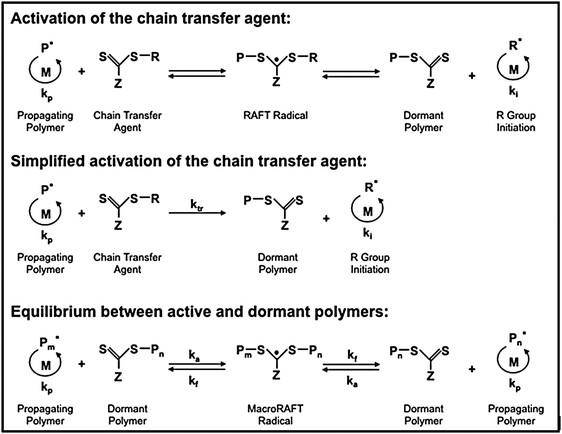
Reversible Addition Fragmentation Chain Transfer Polymerization In Microemulsion Chemical Society Reviews Rsc Publishing Doi 10 1039 C2cs15275d

Scheme 4 Mechanisms Of The Polymerization Of Styrene In The Presence Download Scientific Diagram

Chain Transfer Agent An Overview Sciencedirect Topics

Raft
Chain transfer lowers the degree of polymerization but it does not affect the overall rate of polymerization whereas chain termination via combination and disproportionation decreases both.
Transfer agent polymerization. XR below reduce the average molecular weight by transferring the free radical from the growing polymer chain P to another molecule R. The chain transfer agents used are carbon tetrachloride carbon tetrabromide and four primary mercaptans C 2 nC 4 nC 7 and nC 12. Reversible additionfragmentation chain transfer RAFT polymerization is a reversible deactivation radical polymerization RDRP and one of the more versatile methods for providing living characteristics to radical polymerization.
The reaction affords aldehyde end-capped polymers whose molecular weight can be tuned by varying the ratio of olefinchain-transfer agent. The chain transfer agent containing a 135-trisubstituted benzene ring as core and three dithiocarbamate functionalities attached. Using redox systems as initiators for triggering acrylamide radical polymerization such as in this case mercaptanes are obviously unsuitable as chain transfer agents.
682020 In free radical addition polymerizations sometimes chain transfer agents are added. Industrial free-radical polymerizations are not normally run in solution for economic reasons and the chain transfer agents in these reactions are ingredients that are added deliberately to limit the molecular weight of the polymer. The role of 4-X-thiophenols as chain transfer agents in the polymerization of MMA and AM has been investigated.
From what I understand chain transfer agents eg. Palladium diimine-catalyzed polymerization of olefins using unsaturated alcohols as chain-transfer agents has been demonstrated. They are added to the monomer or monomer blend to regulate.
As chain transfer agent 135-benzyl tri diethyldithiocarbamate was used. 4 Another method to decrease the molecular weight is to carry the reaction in solution medium as. R RAFT is one of the most versatile methods of controlled radical polymerization because it is tolerant of a very wide range of functionality in the monomer and solvent including aqueous solutions.
The chain transfer agent in some laboratory polymerizations is the solvent. 1-7 The historical development of RAFT polymerization at CSIRO has been outlined. Transfer agents that may be used in the free-radical polymerization.

Chain Transfer Agent An Overview Sciencedirect Topics

Evaluate Advantages And Disadvantages Iodine Transfer Radical Polymerization Technique In Comparison With Other Methods Of Controlled Radical Polymerization Give Example Studopediya Net

Reversible Addition Fragmentation Chain Transfer Polymerization An Overview Sciencedirect Topics

Chain Transfer Agents
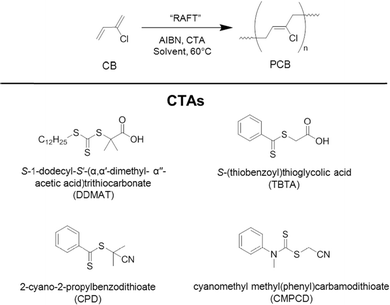
Reversible Addition Fragmentation Chain Transfer Polymerization Of 2 Chloro 1 3 Butadiene Polymer Chemistry Rsc Publishing Doi 10 1039 C3py21151g

Ppt Polymer Chemistry Free Radical Polymerization Powerpoint Presentation Id 3836253

A User Friendly Living Cationic Polymerization Degenerative Chain Transfer Polymerization Of Vinyl Ethers By Simply Using Mixtures Of Weak And Superstrong Protonic Acids

Degenerative Chain Transfer Process Controlling All Chain Growth Polymerizations And Enabling Novel Monomer Sequences Kamigaito 2019 Journal Of Polymer Science Part A Polymer Chemistry Wiley Online Library
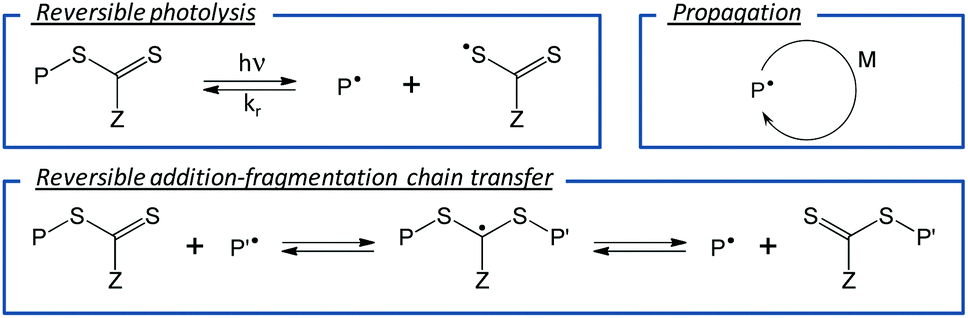
Investigation Into The Mechanism Of Photo Mediated Raft Polymerization Involving The Reversible Photolysis Of The Chain Transfer Agent Polymer Chemistry Rsc Publishing Doi 10 1039 C6py02220k

Chain Transfer

Chain Transfer Matse 202 Introduction To Polymer Materials

Chain Transfer Agent An Overview Sciencedirect Topics
