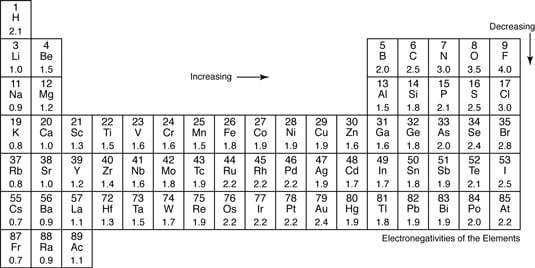
Transfer Of Electrons Electronegativity

Topic 2 Ionic Bonding Transfer Of Electrons Atoms Lose Or Gain Electrons To Become Positively Or Negatively Ch Science Chemistry Ionic Bonding Chemistry

Chemistry Time Bonds And Electronegativity

Electronegativity Bond Scale Surfguppy Chemistry Made Easy Visual Learning Chemistry Classroom Chemistry Teaching Chemistry

18c34fa851f1ae858e3a81451b92f8e6 Jpg 397 716 Pixels Teaching Chemistry Chemistry Lessons Chemistry Classroom

The Periodic Table And Periodic Trends Study Flashcards Periodic Table Chart

Pin On Business Template
This attraction is known as an ionic bond.
Transfer of electrons electronegativity. The rule is that when the electronegativity difference is greater than 20 the bond is considered ionic. Substances such as NaCl and MgCl 2 are the usual examples. At the macroscopic scale ionic compounds form lattices are crystalline solids under normal conditions and have high melting points.
An Introduction to General Organic and Biological Chemistry 12th Edition answers to Chapter 6 - Section 61 - Ions. The most electronegative atom fluorine is assigned a value of 40 and values range down to cesium and francium which are the least electronegative at 07. The higher the associated electronegativity number the more an element or compound attracts electrons towards it.
But if the electronegativity difference between the bonding atoms is too large it results in a complete transfer of electrons. The transfer of electrons between carbon C and oxygen O allows the storage and release of energy transmitted to Earth from the Sun. The greater the difference between atom electronegativity values the more polar the chemical bond formed between them.
Electronegativity is the tendency of an atom to attract electrons in a molecule. 1242020 Electronegativity is an atoms tendency to attract electrons to itself in a chemical bond. The two idealized extremes of chemical bonding.
Ionic Versus Covalent Bonding Ionic compoundsare formed when electrons are transferredfrom one atom to another The transfer of electrons forms ions Each ion is isoelectronic with a noble gas Electrostatic force ionic bond holds atoms together Covalent bondinginvolves sharingof electrons to achieve noble gas configurations for the atoms involved. Ionic bonds are formed by the transfer of electrons between a non metal and a metal. 61b Answer Calcium must lose two electrons to achieve noble gas configuration.
First Ionization Energy of Cobalt. We must keep the phenomenon in the bulk of the solution separate from the phenomenon at the electrodes. Electronegativity is a measure of the attraction of a bonded atom for the pair of electrons in a covalent bond.

Lewis Structure Formal Charge Calculation Mnemonics Dots Lewis

2 4 The Three Types Of Chemical Bonds Are Ionic Covalent And Hydrogen Chemical Bond Covalent Bonding Science Chemistry

Ionbinding Ionic Bonding Chemistry Sample Resume

Pin On Rads

Winter Study Studying Studygram Studyblr School Motivation Instagood Good Goals Studytime School Motivation Study Motivation Studying Inspo
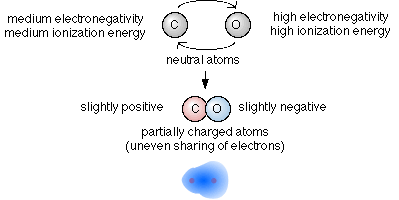
Ionic And Covalent Bonds Overview
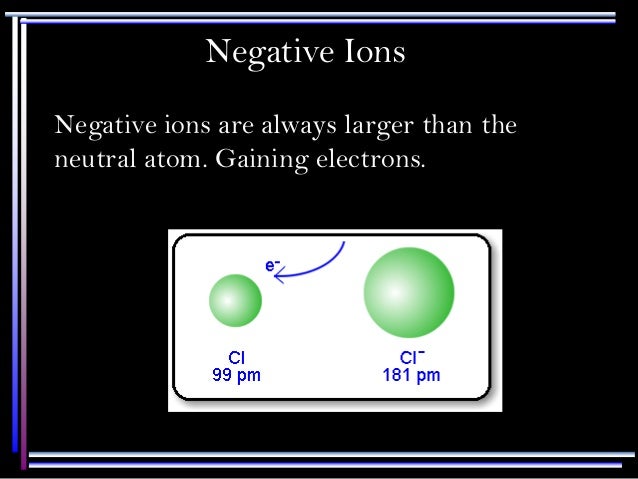
Electronegativity

Electronegativity Measure Of An Atom S Ability To Attract Electrons To Itself In A Covalent Bond Nobl Chemistry Classroom Chemistry Teacher Science Chemistry

Pin On Chemistry

Lesson Info Ionic Bonds Gizmo Explorelearning Ionic Bonding Chemistry Education Teaching Chemistry

Covalent Bonding Pbs Learningmedia Covalent Bonding Chemical Bond Bond

Atoms Ions Chapter Explanation Chemical Bonding Science Chemistry Chemistry Education Ionic Bonding

Ionic Bonding Ca Standards Students Know Atoms Combine To Form Molecules By Sharing Electrons To Form Covalent Or Metallic Ionic Bonding Ionic Ionic Radius